
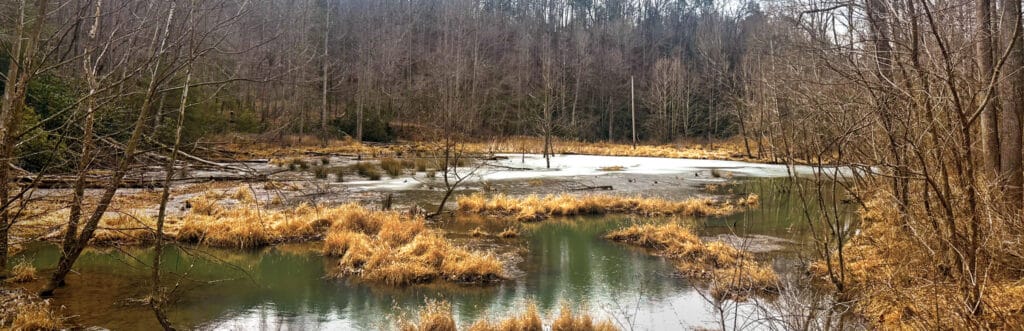
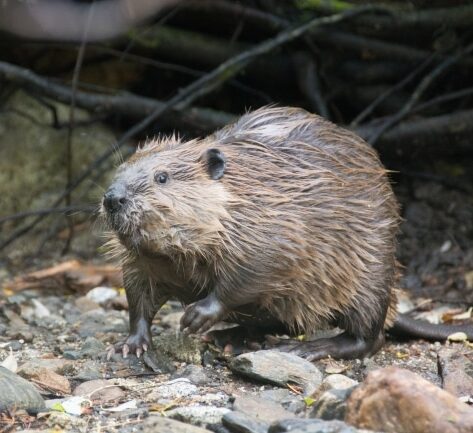
On Warbler Ridge Preserve in Harlan County, there’s an important ecosystem engineer at work: the American beaver.
This native crepuscular rodent, once nearly wiped out from our landscape due to unregulated fur trapping, is considered a keystone species because of the habitat it creates for so many other species.
At Warbler Ridge, beavers have created a five-acre wetland that provides essential habitat for an astounding diversity of plants and animals. The wetland includes an impressive 300-foot-long beaver dam. The dam allows water to slow down and spread across the floodplain at the base of Pine Mountain, and in doing so mitigates flooding downstream from our preserve. The dam also traps excess sediment and allows for cleaner water to flow downstream. In a time when our area is experiencing increasingly more extreme rain and flooding events, the role wetlands like this play to protect our human-built environment is incomparable.
But upstream, we had a less-desirable situation. Our neighbors came to us with concerns about water backing up onto their land upstream from Warbler Ridge. The water was threatening a residential area and community gathering space – in addition to threatening our relationship with our neighbors.
We hoped to find a solution that would allow the beavers to coexist with our neighbors and the beautiful wetland habitat that they have created to persist. We were challenged to think outside of the box.
The Solution
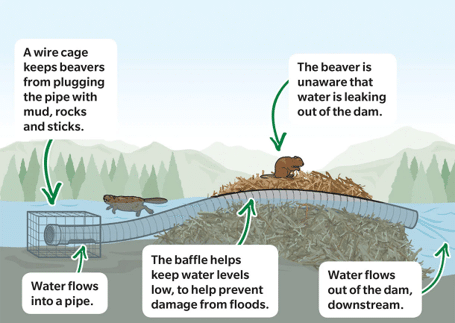
We arrived at a “beaver deceiver”—a pond flow device with a catchy name that regulates the water level above a beaver dam by imperceivably lowering the water upstream to an acceptable level. A relatively simple device, it consists of a long, corrugated pipe that sits within a notched section of the dam and extends more than a dozen feet upstream where its inflow is protected by a large cage and staked deeply into the muck beneath. The distance of the pipe’s inflow from the dam itself and the cage around it help to protect it from being recognized by the resident beavers as the source of their dam’s “leak”.
Thanks to funding from Bell’s Brewery, Snowy Owl Foundation and the Aceso Foundation, KNLT was able to work with two regional ecological consultants – Beaver Creek Hydrology and Plum Hill Ecological Services – in the fall of 2025 to install a beaver deceiver in the dam on our preserve and sufficiently lower the water level upstream. By allowing beavers to remain on the site, we hope to preserve biodiversity while mitigating the impacts of climate change in an especially vulnerable community. This beaver deceiver is one of the first of its kind installed in Kentucky, and we hope that it will be a catalyst that leads to more co-existence between beavers and humans in the future.
About Kentucky Natural Lands Trust
KNLT is a nationally accredited nonprofit working to protect biodiverse and climate resilient landscapes in ways that benefit communities. Through partnerships with individuals, nonprofits, government agencies and businesses, KNLT has safeguarded more than 64,000 acres of wildlands throughout Kentucky and Central Appalachia.
Projects like these would not be possible without the support of our donors! Join our movement and give today:
DONATE NOW
For more information on how you can help KNLT protect wildlands, sign up now to receive our monthly newsletter.
SUBSCRIBE
Cover photo: Warbler Ridge Preserve beaver pond ~ Jess Slade, KNLT
American Beaver ~ Robes Parrish, USFWS
Diagram ~ Kate Francis