A few years ago, on an Earth Day visit to Harlan County High School,
KNLT Outreach Coordinator Megan Falce listened to a student describe spotting a bald eagle along the Poor Fork of the Cumberland River. A seasoned environmental educator, Falce registered the student’s observation as an opportunity, wondering how she could introduce birding education more broadly into classrooms around the region.
In 2025, as KNLT considered applying for a grant from Cornell Lab of Ornithology and the Land Trust Bird Conservation Initiative, Falce’s idea resurfaced as a real possibility. She wanted to take Merlin ID and eBird—two Cornell-developed, crowd-sourced birding apps— into the classrooms of Southeast Kentucky and provide the tools needed for students to participate in citizen science. “That’s when the idea slid right into home base for me,” she said. “We could use part of the grant to show students how to ID bird species and log them. I knew it was something I could present and complete in a workshop setting.”
The Land Trust Bird Conservation Initiative enables land trusts like KNLT to increase their stewardship and public engagement in bird conservation. Privately owned land is critically significant to the breeding, nesting, feeding, and migratory habits of North American birds. American land trusts are uniquely situated to protect these habitats as they partner with private landowners, acquire new properties, and deploy conservation stewardship in wild places.
Spanning more than 125 miles from Tennessee through Kentucky and into Virginia, Pine Mountain lies within one of the most biodiverse temperate regions on Earth. It is a key link in an intercontinental migration route between North, Central, and South America. More than 700 million birds traveled through Kentucky during peak migration in the fall of 2025, according to Cornell Lab data.
“Central Appalachia’s forested ridges are among the most critical—yet often overlooked—corridors for birds in the Mississippi Flyway. To protect this vital ecosystem, we sought out partners like Kentucky Natural Lands Trust: an organization rooted in the land, trusted by local communities, and equipped to work across property lines to safeguard and elevate awareness of this region’s extraordinary biodiversity,” said Sara Barker, Land Trust Bird Conservation Initiative Program Leader.
KNLT is now celebrating the grant’s transformational results. The grant funding supported citizen science and bird research along Pine Mountain and also increased engagement with local communities, schools, and the regional birding community. More than 3,000 people engaged in guided birding hikes, free public workshops, interpretive materials, scientific research, and educational programming. The funding also sparked two major birding initiatives — the Pine Mountain Birding Trail and the Salt Trace Gap Motus station.
“The partnership between the Kentucky Natural Lands Trust and Cornell Lab is turning Pine Mountain into meaningful data for hemispheric bird conservation,” Barker said.
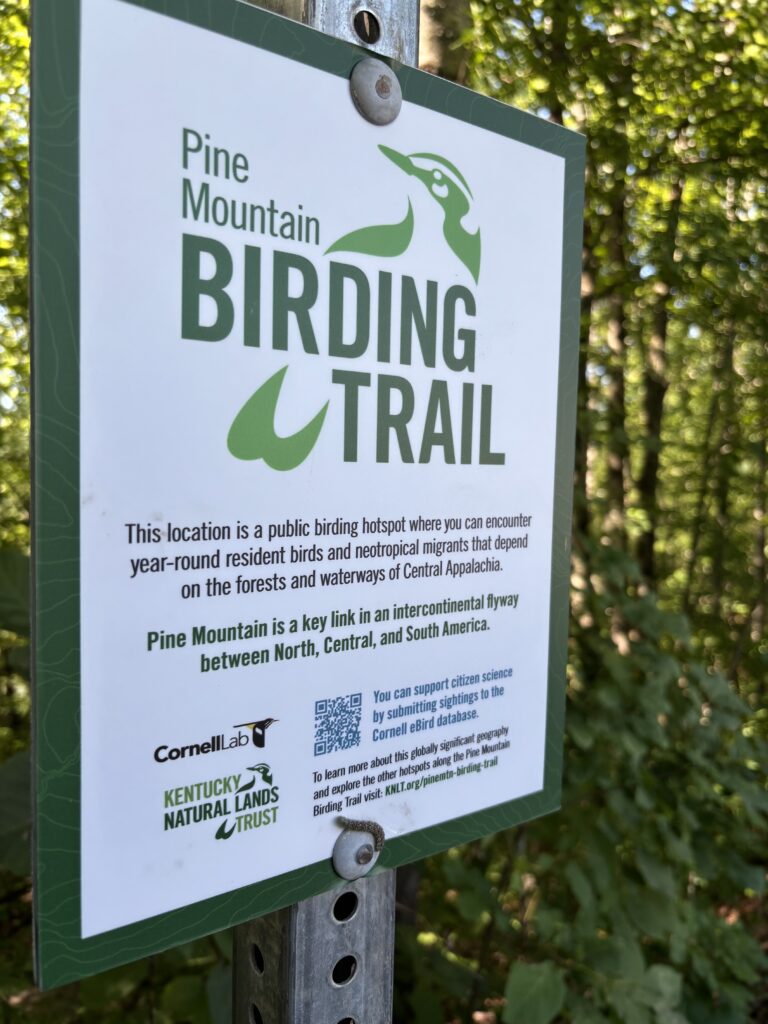
Pine Mountain Birding Trail
The Pine Mountain Birding Trail is a series of six birding “hotspots” where users can encounter and document year-round resident birds and neotropical species. The KNLT trailhead sign at each site features a QR code linking users to Cornell Lab’s eBird app, where they can create birding checklists, track their activity, and share that data to support scientific research, education, and conservation.
Thirty percent of all avifauna in the Western Hemisphere—nearly 3 billion birds—have disappeared since the 1970s due to habitat loss, human encroachment, and climate change. Inversely, public interest in bird conservation and birdwatching has exploded. The bird trail is intended to engage the local community as well as increase the outdoor economy by attracting birders to the region.
The trail was established in partnership with conservation partners including Cornell Lab of Ornithology, Kentucky Ornithological Society, Office of Kentucky Nature Preserves, Kentucky State Parks, and Pine Mountain Settlement School.
Salt Trace Gap Preserve Motus Station
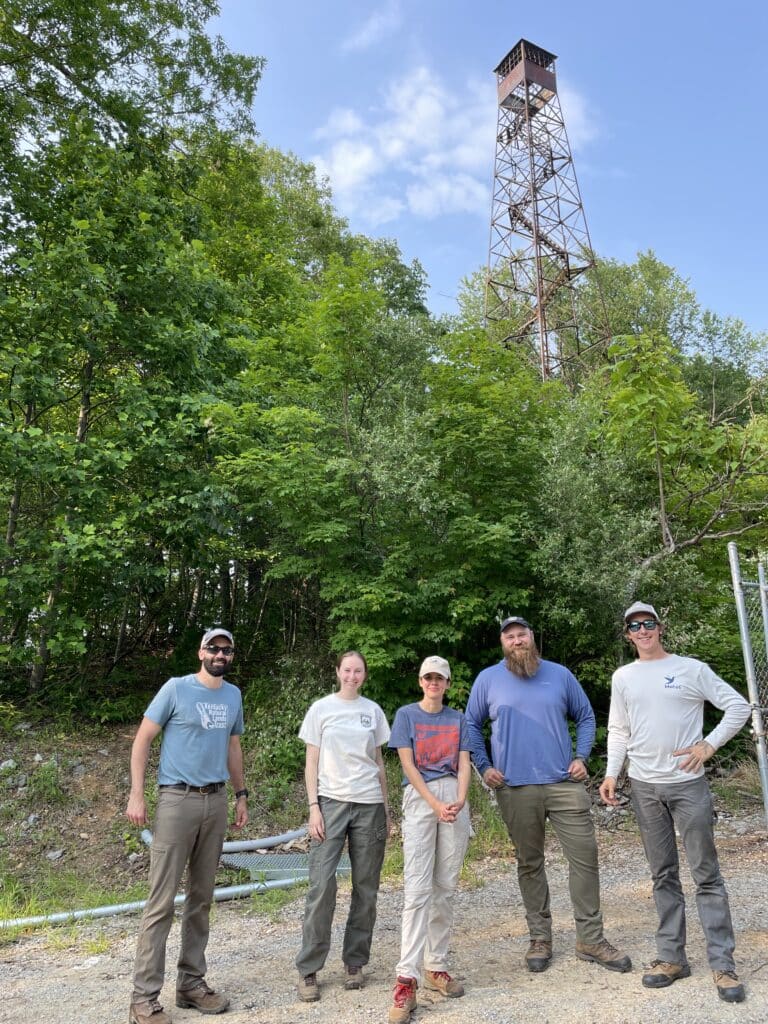
Thanks to Cornell’s grant, KNLT increased bird research on Pine Mountain. Stewardship Manager Derrick Lindsay spearheaded a partnership with the Kentucky Department of Fish and Wildlife Resources and the American Bird Conservancy to establish new bird monitoring on Pine Mountain. Repurposing a decommissioned fire watchtower, the team erected the Salt Trace Gap Preserve Motus Station. The station is connected to the Motus Wildlife Tracking System, which allows citizens, researchers, and others to track and monitor tagged birds, bats, and insects along their migration routes, across continental distances.
Animals are caught and outfitted with a very lightweight transmitter, worn like a backpack, that tracks and logs their movements whenever they fly within ten miles of a Motus station, anywhere in the world. The automation of this data collection and its accessibility is creating innovative, transnational conservation collaborations.
The Salt Trace Gap Motus station has become the most productive station in the entire state. More than 40 tagged individuals representing eight species have flown by the tower to date including: wood thrush, Northern saw-whet owl, Eastern whip-poor-will, Swainson’s thrush, hermit thrush, swamp sparrow, sharp-shinned hawk, and silver-haired bat.
KNLT also developed a Bird Monitoring Protocol as part of the grant. The new protocol complies with ongoing and new efforts for both citizen science and KNLT and partner-led monitoring efforts.
Education and Outreach
In the last year, KNLT engaged more than 3,200 people in birding education and awareness through guided hikes, public workshops, and free public events.
Workshop participants at schools, community centers, and on hiking trails learned how to use Cornell’s e-Bird and Merlin apps, which gives researchers around the world information about birds on Pine Mountain.
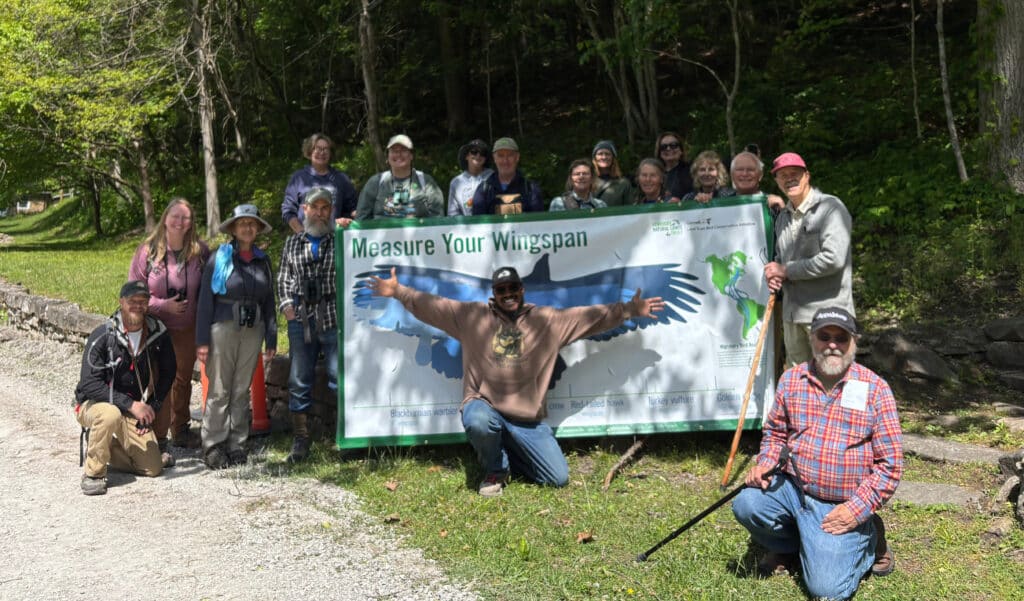
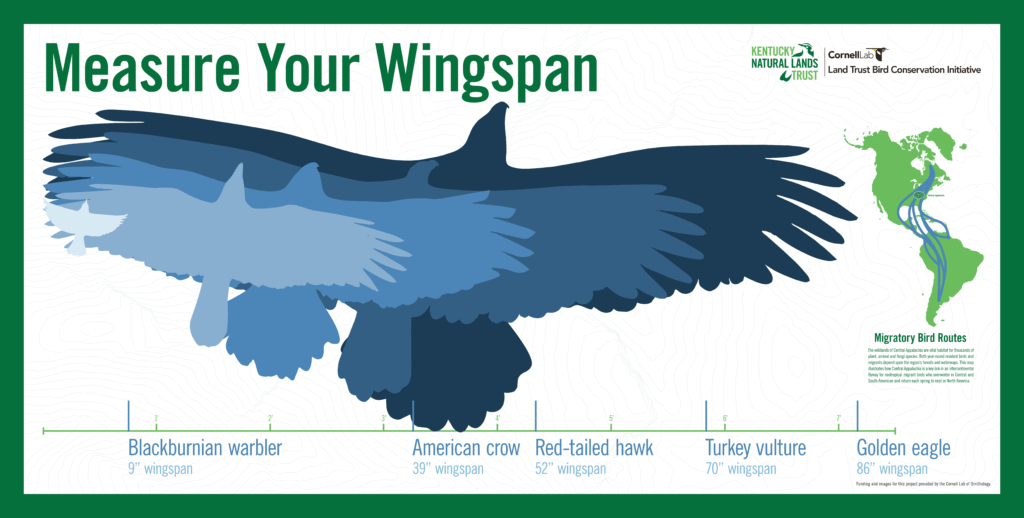
Cornell also helped KNLT develop a “wingspan banner” that allows people to measure their reach in reference to silhouettes of notable regional birds. It’s now a crowd favorite and powerful outreach tool at community events.
KNLT plans to continue birding workshops and other bird-related work across Central Appalachia. Hopefully that will include another workshop at Harlan County High School. Countywide, citizen scientists in Harlan have reported 101 bird sightings on the eBird app this year, including one bald eagle.
About Kentucky Natural Lands Trust
KNLT is a nationally accredited nonprofit working to protect biodiverse and climate-resilient landscapes in ways that benefit communities. Through partnerships with individuals, nonprofits, government agencies, and businesses, KNLT has safeguarded more than 64,000 acres of wildlands throughout Kentucky and Central Appalachia.
Projects like these would not be possible without the support of our donors! Join our movement!
For more information on how you can help KNLT protect wildlands, sign up now to receive our monthly newsletter.
_______________________________________________________________________________
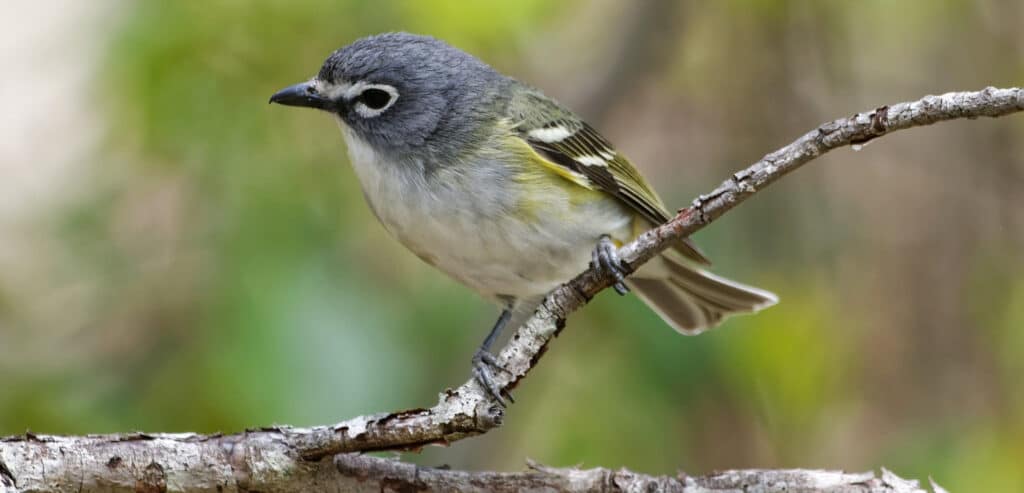
Cover photo, Blue-headed Vireo courtesy of Jennifer Honeycutt
Motus Tower featuring Derrick Lindsay, Chelsea Creech, Mallory Miles, Michael Patton, and Garrett Rhyne, courtesy of Chelsea Creech, KDFWR
Group photo with banner courtesy of Jess Slade, KNLT