
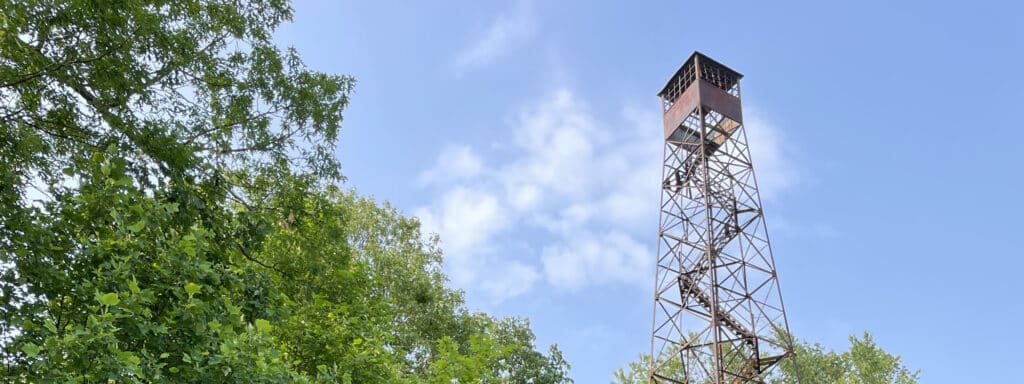
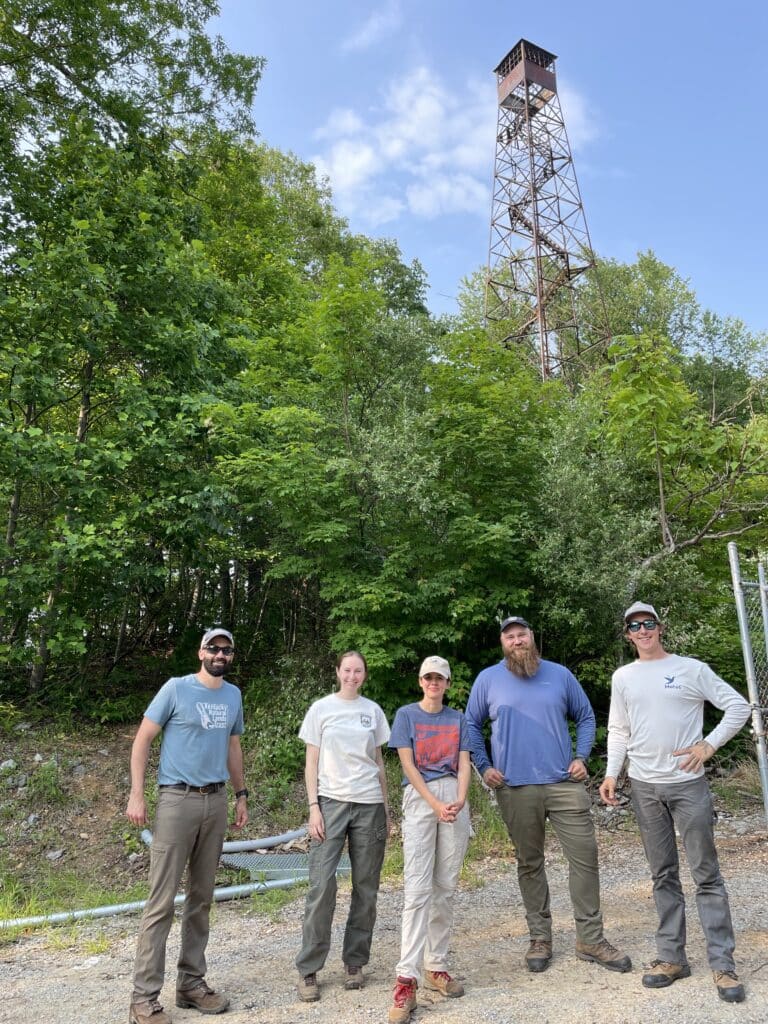
Standing nearly 100 feet above a ridge on Pine Mountain, the forest fire tower at the Salt Trace Gap Preserve commands a panoramic view of the Appalachian Highlands. Like thousands of similar watchtowers designed to protect American forests from wildfires, the structure had been decommissioned and left untouched for decades. But last summer, Kentucky Natural Lands Trust, with partners from the Kentucky Department of Fish and Wildlife Resources and the American Bird Conservancy, repurposed the tower for another critically important conservation objective.
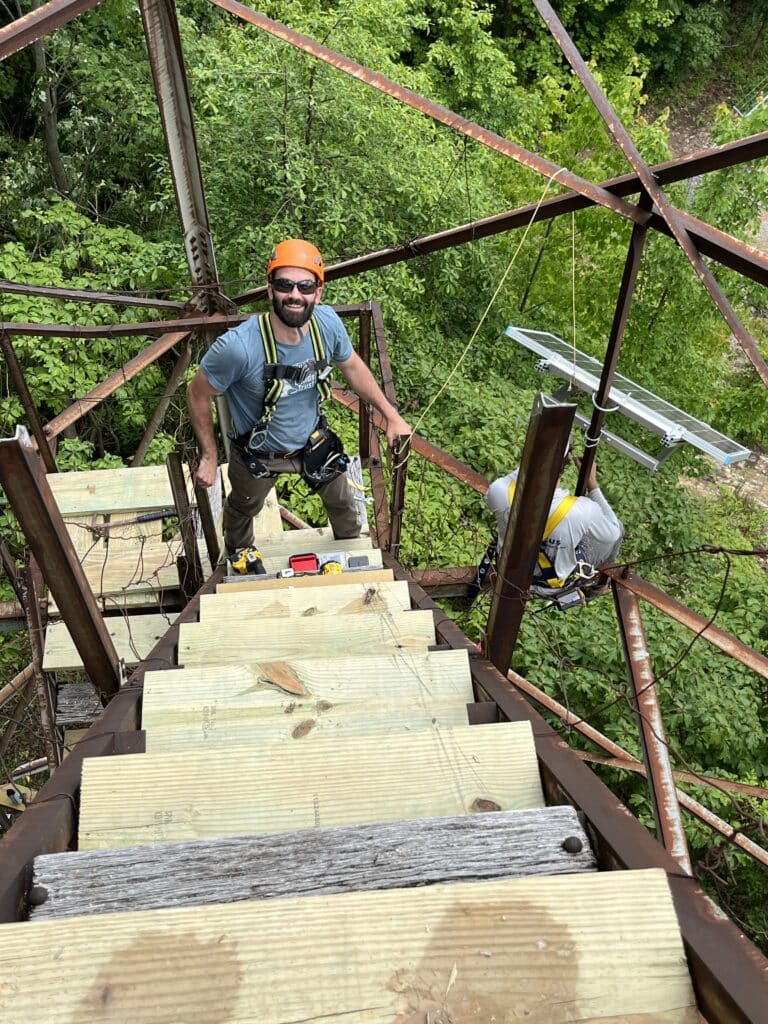
On June 10, 2025, the Salt Trace Gap Motus station powered on, joining a network of more than 2,000 radio telemetry stations worldwide that are revolutionizing how we understand migratory patterns of avian species. The Motus Wildlife Tracking System allows researchers, scientists, land managers, and conservation-minded civilians to track and monitor tagged birds, bats, and insects along their migration routes, across continental distances. Animals are caught and outfitted with a very lightweight transmitter, worn like a backpack, that tracks and logs their movements whenever they fly within ten miles of a Motus station, anywhere in the world. The automation of this data collection and its accessibility is creating innovative, transnational conservation collaborations. These partnerships maximize the benefits of conservation efforts to species experiencing devastating habitat loss.
Nearly 30 percent of all avifauna in the Western Hemisphere—3 billion birds—have disappeared since the 1970s. This devastating erasure is directly tied to habitat loss, human encroachment, climate change, and food cycle disturbance. As ecosystem collapses become all too prevalent, the specificity and adaptability of tools like the Motus system are aiding adaptive conservation strategies across great distances and support an understanding of the full annual cycle of a species migrations.
The Salt Trace Gap Motus station sits high in the forests of Central Appalachia, one of the most biologically diverse temperate regions on planet Earth, and, as part of a continental flyway for migrating songbirds, the site of enormous avian traffic. Crowd-sourced birding apps like eBird and Merlin have elevated public attention to migratory birds and the critical importance of conserving their breeding, stopover, and overwintering grounds. The vast, rugged terrain of the Appalachian Highlands—where citizen science data collection is less concentrated than in urban areas— presents a dilemma for granular data collection. Motus stations are automated, always listening, networked, and constantly updating the searchable database so that researchers, land managers, and citizen scientists can track the movements of individual animals—representative of many others in their species—with incredible specificity, over vast distances, for as long as the bird is alive and moving.
Michael Patton is an avian biologist with the Kentucky Department of Fish and Wildlife Resources (KDFWR).
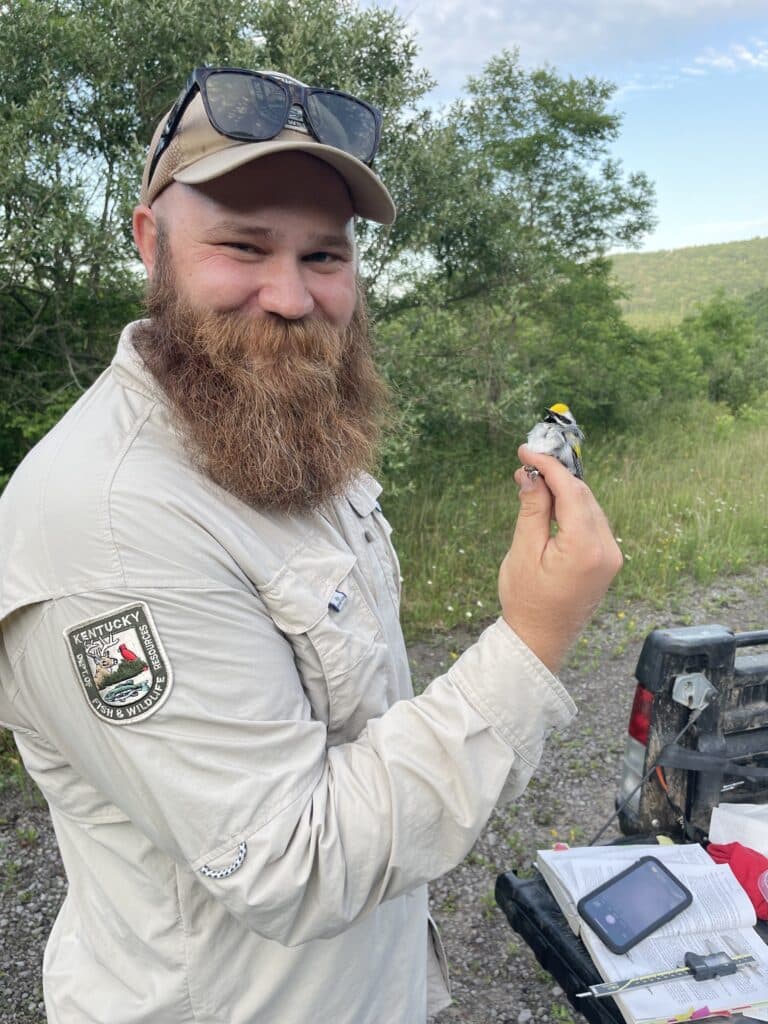
Michael was a key partner in bringing the Salt Trace Gap Motus station online. He discussed the ways Motus tracking is supplementing ornithology and conservation in our region and beyond.
“At the local level, Motus is great for understanding how territory sizes change over the year and how individuals are competing with one another. The bonus is the really long-distance movement data. The Motus network is filling in the gaps of knowledge about migratory movements of species that were previously impossible to study…
“We’ve always known that the Appalachian Mountains serve as a corridor for a number of different species, particularly migrating songbirds. We’d see them ping off of stations in Tennessee and West Virginia and whatnot, but it was a shame that we didn’t have one of these Motus stations capturing the movements of all these birds moving through SE Kentucky. The partnership with KNLT will help facilitate the station, maintain it, and help us have access to regional movement data that we did not have before.”
To understand and protect the full annual cycle of bird migrations, researchers and conservation groups are using Motus data and sharing information to create new strategies that cross manmade borders. Patton and his colleague are working on a study in which over 1,100 Wood thrushes, a species whose numbers are declining across their range, were outfitted with MOTUS nanotags and are being tracked along their migratory route. The data is being shared with conservation organizations in Central America, where the birds spend the winter.
“We’ve learned a tremendous amount of information about…their large-scale movements, timing, and site fidelity. Their site fidelity is absolutely incredible. A Wood thrush that breeds at one point in Kentucky in May will come back to that same point if it survives migration. I’m not sure that’s been recorded in Kentucky before.
“We can do all the work possible here to conserve habitat, and that’s great, but if there are problems in between here and their wintering grounds during that migration, it’s impossible to conserve that species: you can’t just have wonderful habitat in one place in their life cycle. If their habitat is compromised along the way, they’re not going to make it through the winter or make it through migration. We’re using Motus to fill in the gaps of where these Kentucky birds are going—exactly—and how we can help facilitate the work of conservation partners in their wintering grounds.”
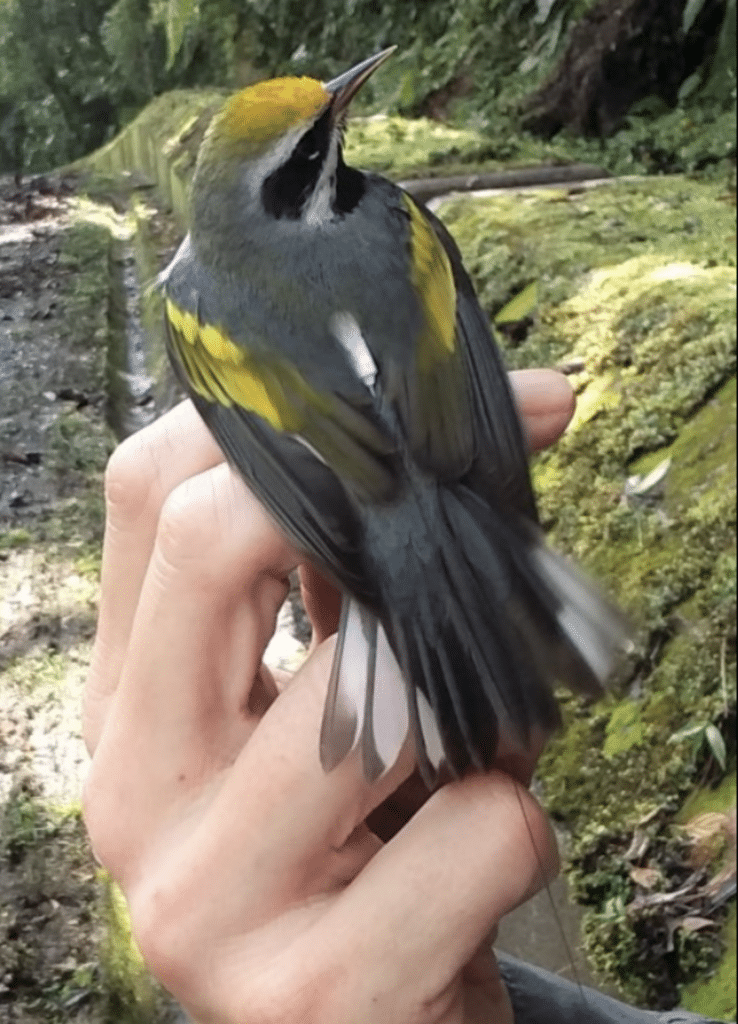
Kentucky Department of Fish and Wildlife Resources works with a nonprofit called Southern Wings that connects state agencies in the U.S. to conservation organizations in Central and South America. By directly funding the restoration of specific habitats along the migratory path, KDFWR is protecting Cerulean warblers and Golden-winged warblers, species needing conservation in KY and across their range.
Kentucky currently has eighteen Motus stations, and while the Salt Trace Gap site is the newest among them, it has also recorded the most activity since it came online. KNLT and KDFWR will collaborate on the maintenance of another Motus station coming online later in 2026. Additionally, KNLT applied for and received grant funding from Southern Conservation Partners to purchase ten Motus nanotags. This summer, KNLT Stewardship Manager Derrick Lindsay will join Michael Patton and his team to capture and tag ten Kentucky Warblers to track and study their migration patterns.
The planning and maintenance of new Motus stations on Pine Mountain, and the partnerships KNLT has established in support of the efforts, highlight our commitment to biodiversity conservation in Central Appalachia and our support of globally significant scientific research.
KNLT believes in the power of partnership. We are grateful for the support of individual donors, foundations, and partners. We thank the James Graham Brown Foundation, the Cornell Lab of Ornithology and the Southern Conservation Partners for making this project possible. KNLT is thrilled to continue working on this important research with the Kentucky Department of Fish and Wildlife Resources, American Bird Conservancy, and other partners moving forward.
About Kentucky Natural Lands Trust
KNLT is a nationally accredited nonprofit working to protect biodiverse and climate-resilient landscapes in ways that benefit communities. Through partnerships with individuals, nonprofits, government agencies, and businesses, KNLT has safeguarded more than 64,000 acres of wildlands throughout Kentucky and Central Appalachia.
Projects like these would not be possible without the support of our donors! Join our movement!
For more information on how you can help KNLT protect wildlands, sign up now to receive our monthly newsletter.
________________________________________________________________________________________
Photos
Cover photo courtesy of Chelsea Creech, KDFWR
KNLT Stewardship Manager Derrick Lindsay and Garret Rhnye of American Bird Conservancy, courtesy of Mallory Miles, KDFWR
Michael Patton with Golden-winged warbler, courtesy of Michael Patton, KDFWR
Golden-winged warbler with Motus nanotag, courtesy of Michael Wells, SELVA
Group photo: Derrick Lindsay, Chelsea Creech, Mallory Miles, Michael Patton, and Garrett Rhyne, courtesy of Chelsea Creech, KDFWR